


Showing posts with label News. Show all posts
Showing posts with label News. Show all posts
Wednesday, March 10, 2010

Saturday, January 30, 2010
3DTV is 'Not going to be easy'

Bringing 3DTV to the home is 'not going to be easy, and there will be surprises' said standards expert Peter Symes of SMPTE yesterday.
Speaking at a high-end Digital Television Group (DTG) seminar to which HCC had exclusive access, Symes explained that the technicalities of encoding 3D signals were proving a challenge - for instance, early attempts at compressing signals using MVC (Multi-View Coding) delivered disappointingly inefficient results.
It wasn't the only note of caution sounded at the seminar, at which the DTG announced that it would be working to set standards for 3D delivery to UKTVs and computers.
Chris Johns, Chief Engineer of BSkyB,explained that new techniques had to be developed to create 3D material which delivers 'Emotional involvement, rather than the spear-in-your-face effect'.
Johns demoed Sky's 3D sports footage, which concentrates on creating a wide immersive sense of perspective, rather than gimmicky effects. Partly this is due to the limitations of the 3D camera rigs, partly because viewers might find the 3D effect tiring if it isn't strictly controlled.
Another note of caution was sounded by Simon Parnall of firmware developer NDS, whose research suggests that a 3D effect designed to work on a large screen viewed from a specific distance might not work on a smaller setup, creating a requirement for rescaling according to the size of your TV.
While the DTG, which maintains the standard for Freeview transmission and hardware, works on defining a 3D standard for UK TV, manufacturers are still competing to come up with different delivery systems - Sony, Samsung and Panasonic with active LED shuttered glasses, LG with a polarised passive glasses system.The 3D broadcast standard will have to be 'platform agnostic', working on either kind of TV, as is the HDMI 1.4 cable standard, discussed by Steve Venuti of the HDMI licensing body at the seminar.
We're tempted to wonder whether it isn't worth waiting until 2020, when technology consultants ZetaCast suggested that we might expect to see 'lightfield' 3D - in other words, a Star Wars-type 'holographic' system which captures every element of the light from a scene, so it can be viewed from any angle.
Based mainly on predictions of the processing power needed to handle the amounts of data involved, the estimate seems a bit optimistic to us - but at least you wouldn't have to wear those silly glasses.
Speaking at a high-end Digital Television Group (DTG) seminar to which HCC had exclusive access, Symes explained that the technicalities of encoding 3D signals were proving a challenge - for instance, early attempts at compressing signals using MVC (Multi-View Coding) delivered disappointingly inefficient results.
It wasn't the only note of caution sounded at the seminar, at which the DTG announced that it would be working to set standards for 3D delivery to UKTVs and computers.
Chris Johns, Chief Engineer of BSkyB,explained that new techniques had to be developed to create 3D material which delivers 'Emotional involvement, rather than the spear-in-your-face effect'.
Johns demoed Sky's 3D sports footage, which concentrates on creating a wide immersive sense of perspective, rather than gimmicky effects. Partly this is due to the limitations of the 3D camera rigs, partly because viewers might find the 3D effect tiring if it isn't strictly controlled.
Another note of caution was sounded by Simon Parnall of firmware developer NDS, whose research suggests that a 3D effect designed to work on a large screen viewed from a specific distance might not work on a smaller setup, creating a requirement for rescaling according to the size of your TV.
While the DTG, which maintains the standard for Freeview transmission and hardware, works on defining a 3D standard for UK TV, manufacturers are still competing to come up with different delivery systems - Sony, Samsung and Panasonic with active LED shuttered glasses, LG with a polarised passive glasses system.The 3D broadcast standard will have to be 'platform agnostic', working on either kind of TV, as is the HDMI 1.4 cable standard, discussed by Steve Venuti of the HDMI licensing body at the seminar.
We're tempted to wonder whether it isn't worth waiting until 2020, when technology consultants ZetaCast suggested that we might expect to see 'lightfield' 3D - in other words, a Star Wars-type 'holographic' system which captures every element of the light from a scene, so it can be viewed from any angle.
Based mainly on predictions of the processing power needed to handle the amounts of data involved, the estimate seems a bit optimistic to us - but at least you wouldn't have to wear those silly glasses.
3DTV is 'Not going to be easy, and there will be surprises' says standards guru
 Bringing 3DTV to the home is 'not going to be easy, and there will be surprises' said standards expert Peter Symes of SMPTE yesterday. Speaking at a high-end Digital Television Group (DTG) seminar to which HCC had exclusive access, Symes explained that the technicalities of encoding 3D signals were proving a challenge - for instance, early attempts at compressing signals using MVC (Multi-View Coding) delivered disappointingly inefficient results.
It wasn't the only note of caution sounded at the seminar, at which the DTG's Simon Gauntlett announced that it would be working to set standards for 3D delivery to UK TVs and computers.
Chris Johns, Chief Engineer of BSkyB, explained that new techniques had to be developed to create 3D material which delivers 'Emotional involvement, rather than the spear-in-your-face effect'. Johns demoed Sky's 3D sports footage, which concentrates on creating a wide immersive sense of perspective, rather than gimmicky effects. Partly this is due to the limitations of the 3D camera rigs, partly because viewers might find the 3D effect tiring if it isn't strictly controlled.
Another note of caution was sounded by Simon Parnall of firmware developer NDS, whose research suggests that a 3D effect designed to work on a large screen viewed from a specific distance might not work on a smaller setup, creating a requirement for rescaling according to the size of your TV.
While the DTG, which maintains the standard for Freeview transmission and hardware, works on defining a 3D standard for UK TV, manufacturers are still competing to come up with different delivery systems - Sony, Samsung and Panasonic with active LED shuttered glasses, LG with a polarised passive glasses system. The 3D broadcast standard will have to be 'platform agnostic', working on either kind of TV.
Steve Venuti of the HDMI licensing body introduced the HDMI 1.4 cable standard at the seminar. This was widely welcomed as a way of supporting a wide range of 3D techniques while making it easier for developers to conform to standards.
Still, we're tempted to wonder whether it isn't worth waiting until 2020, when technology consultants ZetaCast suggested that we might expect to see 'lightfield' 3D - in other words, a Star Wars-type 'holographic' system which captures every element of the light from a scene, so it can be viewed from any angle. Based mainly on predictions of the processing power needed to handle the amounts of data involved, the estimate seems a bit optimistic to us - but at least you wouldn't have to wear those silly glasses.
Final 3-D Blu-ray Specification Announced
 The Blu-ray Disc Association (BDA) today announced the finalization and release of the “Blu-ray 3D™” specification. It leverages the technical advantages of the BD format to deliver “unmatched picture quality” as well as uniformity and compatibility across the full range of Blu-ray 3D products, both hardware and software. The specification is also designed to allow the PS3 to play back Blu-ray 3D content in 3-D.
Notably, the specification allows every player and movie supporting it to deliver full HD 1080p resolution to each eye. Moreover, the specification is display agnostic, meaning that Blu-ray 3D products will deliver the 3-D image to any compatible 3-D display, regardless of whether that display uses LCD, plasma or other technology and regardless of what 3-D technology the display uses to deliver the image to the viewer's eyes.
Regarding compatibility, the specification supports playback of 2-D discs in forthcoming 3-D players and can enable 2-D playback of Blu-ray 3D discs on the installed base of Blu-ray Disc players currently in homes around the world.
The Blu-ray 3D specification calls for encoding 3-D video using the Multiview Video Coding (MVC) codec, an extension to the ITU-T H.264 Advanced Video Coding (AVC) codec currently supported by all Blu-ray Disc players. MPEG4-MVC compresses both left and right eye views with a typical 50% overhead compared to equivalent 2-D content, and can provide full 1080p resolution backward compatibility with current 2-D Blu-ray Disc players. The specification also incorporates enhanced graphic features for 3-D. These features provide a new experience for users, enabling navigation using 3-D graphic menus and displaying 3-D subtitles positioned in 3-D video.
The completed specification will be available shortly and provides individual manufacturers and content providers with the technical information and guidelines necessary to develop, announce and bring products to market pursuant to their own internal planning cycles and timetables.
“Throughout this year, movie goers have shown an overwhelming preference for 3-D when presented with the option to see a theatrical release in either 3-D or 2-D,” said Victor Matsuda, chairman, BDA Global Promotions Committee. “We believe this demand for 3-D content will carry over into the home now that we have, in Blu-ray Disc, a medium that can deliver a quality Full HD 3-D experience to the living room.”
“From a technological perspective, it is simply the best available platform for bringing 3D into the home,” said Benn Carr, chairman, BDA 3D Task Force. “The disc capacity and bit rates Blu-ray Disc provides enable us to deliver 3D in Full HD 1080p high definition resolution.”
“In 2009 we saw Blu-ray firmly establish itself as the most rapidly adopted packaged media format ever introduced,” said Matsuda. “We think the broad and rapid acceptance Blu-ray Disc already enjoys with consumers will be a factor in accelerating the uptake of 3-D in the home. In the meantime, existing players and libraries can continue to be fully enjoyed as consumers consider extending into 3-D home entertainment.”
A note on spelling
Earlier this year, the blu-ray.com team unanimously decided to use the spelling "3-D", with a hyphen, for everything related to stereoscopic images, and "3D", without a hyphen, for three-dimensional graphics and animation. We shall continue to do so, except when citing the name of the “Blu-ray 3D” specification, which doesn't use the hyphen
Tuesday, January 26, 2010
Philips shuts down 3D research arm
 Philips shuts down 3D research arm
Company puts its three-dimensional future in doubt
Philips, one of the biggest early adopters of 3D television in the home, has cast doubts over its future plans in the 3D market after closing its 3D technology research division.
The company announced to Computer Shopper, explaining that "it is still something that we're closely monitoring in the long term but there's no short to medium term plans for a Philips consumer 3D TV business."
WOW factor
Philips had been championing WOWvx autostereoscopic technology which allows consumers in the home to watch 3D without the need of glasses.
The 42-inch TVs utilises a 2D+ depth format. This essentially means they are capable of showing 2D content using smart software interpolation.
They are currently available in the UK market for around £7,000.
Currently, LG is another manufacturer who is looking to bringing no-glasses 3D to the home, with the likes of Sony and Panasonic looking into three-dimensional tellies that require the use of glasses.
Panasonic continuing efforts
In fact, Panasonic just announced at NAB it is bolstering its 3D output. It is to start development on a new 'Professional 3D Production System', which consists of a twin-lens P2 professional camera recorder and a 3D-compatible High Definition Plasma display.
The company explained at the broadcasting event taking place in Los Angeles this week that it is "continuing its efforts to enable consumers to enjoy 3D movies in the comfort of their own living rooms with its 3D Full HD Plasma Home Theater System, which incorporates a Plasma HDTV and a Blu-ray Disc player."
3D TV: the sets heading your way in 2010
But are we ready to upgrade our TVs already?

Before the release of Avatar in December, nerves must have been high in the AV industry about their upcoming 3D announcements at CES 2010.
Sure, there were a number of 3D-related movies on the roster. But while UP, Monsters Versus Aliens and A Christmas Carol were all a successes, they gently rocked the box-office boat rather than setting it on fire.
To break box-office records, it would need somebody who was well aware of creating big movies. That somebody was James Cameron.
Now that Avatar is the second biggest movie of all time – with Cameron's Titanic still in number-one spot – the proliferation of 3D announcements at CES makes complete sense to the mainstream media.
But look beyond the deeply flawed idea that whatever 3D success is happening in the cinema at the moment can be echoed in the home and what you have is a nervous TV industry looking to 3D as a saviour.
The AV industry has been pushing the idea of 3D in the home for some time now (both Sony and Panasonic chose IFA 2009 to pledge allegiance) but CES 2010 will be remembered for its 3D slant.
But why 3D and why now? A lot of it has to do with the muted response to Blu-ray by consumers, and the industry looking for the next big thing after HDTV.
Yes, HD is bigger than ever and more people have HD-ready sets in their homes, but prices have hit rock bottom. You only have to look in your local Asda to see the results of this.
Rock-bottom prices are not great for TV manufacturers. Although they always want TVs to be 'affordable', there needs to be enough space in the pricing to make a profit.
3D TV is perfect for money-making. Sony, one of the big guns in the 3D world, is to start making 3D-Ready badges for its upcoming range of TVs. Each TV with one of these badges will cost significantly more that a non-3D version being released.
Even though there will be a significant lack of 3D media to play on your 3D TVs, you have to remember that this hasn't stopped consumers buying an HDTV before they have anything that pipes out HD content to plug to the telly. Consumers love a bit of future proofing now and again.

Before the release of Avatar in December, nerves must have been high in the AV industry about their upcoming 3D announcements at CES 2010.
Sure, there were a number of 3D-related movies on the roster. But while UP, Monsters Versus Aliens and A Christmas Carol were all a successes, they gently rocked the box-office boat rather than setting it on fire.
To break box-office records, it would need somebody who was well aware of creating big movies. That somebody was James Cameron.
Now that Avatar is the second biggest movie of all time – with Cameron's Titanic still in number-one spot – the proliferation of 3D announcements at CES makes complete sense to the mainstream media.
But look beyond the deeply flawed idea that whatever 3D success is happening in the cinema at the moment can be echoed in the home and what you have is a nervous TV industry looking to 3D as a saviour.
The AV industry has been pushing the idea of 3D in the home for some time now (both Sony and Panasonic chose IFA 2009 to pledge allegiance) but CES 2010 will be remembered for its 3D slant.
But why 3D and why now? A lot of it has to do with the muted response to Blu-ray by consumers, and the industry looking for the next big thing after HDTV.
Yes, HD is bigger than ever and more people have HD-ready sets in their homes, but prices have hit rock bottom. You only have to look in your local Asda to see the results of this.
Rock-bottom prices are not great for TV manufacturers. Although they always want TVs to be 'affordable', there needs to be enough space in the pricing to make a profit.
3D TV is perfect for money-making. Sony, one of the big guns in the 3D world, is to start making 3D-Ready badges for its upcoming range of TVs. Each TV with one of these badges will cost significantly more that a non-3D version being released.
Even though there will be a significant lack of 3D media to play on your 3D TVs, you have to remember that this hasn't stopped consumers buying an HDTV before they have anything that pipes out HD content to plug to the telly. Consumers love a bit of future proofing now and again.
AMD to demo 3D Blu-ray standard

AMD has announced it is to show off its 3D Blu-ray technology at CES 2010, showing the technology world just what the future Blu-ray standard will be capable of.
Even though the Blu-ray 3D standard hasn't been finalised yet, AMD has decided to jump the gun to show off its version of the technology, in conjunction with software makers CyberLink.
New entertainment experience
"AMD has a long, proud tradition of delivering leading technologies to market – technologies that have a meaningful and positive impact on the PC experience," explained Rick Bergman, Senior Vice President, AMD Products Group.
"Stereoscopic 3D is set to be one of these technologies, and that's why AMD has committed the time and resources to ensure that when Blu-ray stereoscopic 3D is ready for the world, AMD will be ready to bring it to consumers, just as we have done recently with DirectX 11-capable hardware to support DirectX 11 gaming."
There's no other news regarding just what will be shown off, although Alice H Chang, CEO of CyberLink, has hinted that: "AMD has been a valuable partner, developing hardware optimised for the highest quality video and audio experience with PowerDVD Ultra" and that CyberLink is "ready to bring consumers an incredible new entertainment experience in the coming year".
Even though the Blu-ray 3D standard hasn't been finalised yet, AMD has decided to jump the gun to show off its version of the technology, in conjunction with software makers CyberLink.
New entertainment experience
"AMD has a long, proud tradition of delivering leading technologies to market – technologies that have a meaningful and positive impact on the PC experience," explained Rick Bergman, Senior Vice President, AMD Products Group.
"Stereoscopic 3D is set to be one of these technologies, and that's why AMD has committed the time and resources to ensure that when Blu-ray stereoscopic 3D is ready for the world, AMD will be ready to bring it to consumers, just as we have done recently with DirectX 11-capable hardware to support DirectX 11 gaming."
There's no other news regarding just what will be shown off, although Alice H Chang, CEO of CyberLink, has hinted that: "AMD has been a valuable partner, developing hardware optimised for the highest quality video and audio experience with PowerDVD Ultra" and that CyberLink is "ready to bring consumers an incredible new entertainment experience in the coming year".
Will plasma beat LCD in the 3D quality stakes ?
Will plasma beat LCD in the 3D quality stakes?

Panasonic has come true to its 3D word and shown off its upcoming range of 3D plasma screens at CES 2010.
For the company, this year's CES is all about 3D, with Panasonic pushing the fact that it has a whole end-to-end 3D eco system – from camera to television. But what consumers really care about is what 3D will look like, and you can take it from us, on the VT25, it is stunning.
We spoke to Panasonic about why it felt that plasma was a better proposition for 3D (bearing in mind that Sony has chosen LCD) and it told us that blacks were blacker and faster response times mean less blurring.
When we mentioned that plasma seems to be phasing out now that LCD TVs can handle 50-inch plus screen sizes, Panasonic assured us that plasma isn't going away, if anything it's getting better.
Coming in 50, 55 and 60-inch flavours, the VT25 is a beautiful TV and one which takes over from the V10 range of last year.

Panasonic has come true to its 3D word and shown off its upcoming range of 3D plasma screens at CES 2010.
For the company, this year's CES is all about 3D, with Panasonic pushing the fact that it has a whole end-to-end 3D eco system – from camera to television. But what consumers really care about is what 3D will look like, and you can take it from us, on the VT25, it is stunning.
We spoke to Panasonic about why it felt that plasma was a better proposition for 3D (bearing in mind that Sony has chosen LCD) and it told us that blacks were blacker and faster response times mean less blurring.
When we mentioned that plasma seems to be phasing out now that LCD TVs can handle 50-inch plus screen sizes, Panasonic assured us that plasma isn't going away, if anything it's getting better.
Coming in 50, 55 and 60-inch flavours, the VT25 is a beautiful TV and one which takes over from the V10 range of last year.

However, built around Panasonic's Full HD 3D proprietary technology, they definitely compete well with RealD's glasses, which have been picked up by Sony and the like.

Avatar's 3D planet leaves moviegoers 'depressed and suicidal'
 James Cameron's opus Avatar may well be the kick-start 3D needs to take over the AV world, but the director has made the planet of Pandora so lifelike that moviegoers leaving cinemas are feeling 'depressed' and 'suicidal' over the thought of not actually being able to visit the planet in real life.
The web has been awash with slightly delusional fans who have gone on to the 'Avatar Forums' where there are subjects such as: 'Ways to cope with the depression of the dream of Pandora being intangible,' which has over 1,000 posts so far.
Fill the emptiness
Some of the more intriguing posts (including grammatical errors) read: "I can't stop thinking about all the things that happened in the film and all of the tears and shivers i got from it.
"I even contemplate suicide thinking that if i do it i will be re birthed in a world similar to Pandora and the everything is the same as in Avatar…"
Another notes: "After I watched Avatar at the first time, I trully felt depressed as I "wake" up in this world again. So after few days, I went to cinema and watched it again for the second time to relieve the depression and hopeless feeling."
We're not sure if a similar feeling was felt across the web when Cloudy, With A Chance Of Meatballs was released - "I'm deeply unhappy that food doesn't actually fall from the sky" - but the forum does show the power 3D (and the world of Pandora) is having on Joe Public.
Well, Joe Public who spends his nights trawling the Avatar forums looking for some sort of solace.
No 3D Blu-ray for Avatar… for now at least
 James Cameron's Avatar, the most successful 3D movie ever, and the film 3D evangelist Panasonic is basing its 3D Blu-ray and TV launch plans on for 2010, looks certain to debut on Blu-ray in standard 2D format.
During an exclusive technology briefing at Fox Studios in LA, Chief Technologist Danny Kaye downplayed Avatar's anticipated 3D debut, telling HCC: 'Do not make the assumption that Avatar will be the first 3D Blu-ray from Fox.'
The standard Fox window from theatrical to disc is four months. This puts Avatar on schedule for a launch in April 2010. With Panasonic's first 3D Blu-ray player and TV range unlikely to start shipping until early summer, this puts the blockbuster out of sync with any initial hardware rollout.
A far better bet is Fox's other 3D blockbuster Ice Age 3D. The 2D version debuted on Blu-ray last November, leaving a respectable gap (and plenty of product development time) for an Ice Age 3D Special Edition to be released alongside any hardware introductions in 2010. It seems reasonable to assume that Avatar will follow the same double-dip path, with a 3D Special Edition released after the standard 2D release.
According to 20th Century Fox, the 3D blockbuster earned over $350m (£217m) in the US and over $670m (£415m) outside of the US in its first 17 days on screens.
A question of cost
It also seems unlikely that 3D movies will ship with free 3D glasses, as has been the practice with anaglyph movie releases. Fox's Danny Kaye says it's down to cost. 'I'm guessing that the TV manufacturers are going to put glasses in the box, as well as bundle the new 3D players with glasses. These (new) 3D glasses don't cost 50c or a dollar each. Eighteen months ago a pair of active shutter glasses for the home would cost well over 100 dollars, today they are around 25 dollars.'
But he doesn't think this will limit the availability of 3D eyewear. 'You're going to see designer companies getting involved, making cool looking and comfortable glasses. I've seen styles that can be worn by people that already wear glasses, because the nose bridge moves. You'll be able to buy glasses for a six year or a 40 year old. Everyone intends to give consumers easy access.'
Panasonic, along with Samsung, Sony and others will reveal their first 3D hardware lines at CES this week. According to market analysts DisplaySearch, the 3D TV market could be worth as much as $22 billion by 2018.
Monday, September 28, 2009
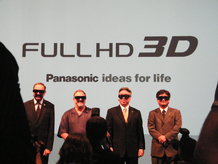
Panasonic announces 50-inch 1080p 3D Plasma
 Uses Panny's active shutter specs to bring the cinema home
Panasonic has announced a new 50-inch 1080p 3D Plasma TV, with a prototype set to be unveiled at the Ceatec show in Tokyo in early October.
If you happen to be at Ceatec Japan on October 6 then be sure to pay a visit to Panny's booth where the company's 50-inch Full HD 3D compatible plasma display panel (PDP) with high-precision active shutter glasses will be there for your viewing pleasure.
Panasonic hopes to make the new 50-inch 3D Plasma available to consumers at some point in 2010.
Panasonic informs us that the latest 50-inch 3D PDP "uses Panasonic's newly-developed high-speed 3D drive technology that enables rapid illumination of pixels while maintaining brightness"
The press release continues: "The panel also incorporates a crosstalk reduction technology allowing for minimising double-image (ghosting) that occurs when left- and right-eye images are alternately displayed."
50-inch 3D TVs most popular
The new 3D PDP and glasses evolved from Panasonic's world-first Full HD 3D 103-inch Plasma originally developed back in 2008. 50-inch is expected to become the most popular size for 3D TV in the home.
Panasonic hopes that it can be the first to market with its "original Full HD 3D technology to create synergy between PDPs, which excel in moving picture resolution and colour reproduction, and Blu-ray Disc players, which are able to faithfully reproduce high quality Hollywood 3D movies."
Ceatec Japan 2009 is set to be held from October 6 to 10 at Makuhari Messe in Chiba City, Tokyo.
Subscribe to:
Posts (Atom)